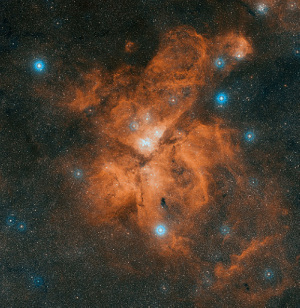
Optical image of the Carina Nebula (ESO Images)
Information on the
Chandra Carina
Complex Project
(CCCP)
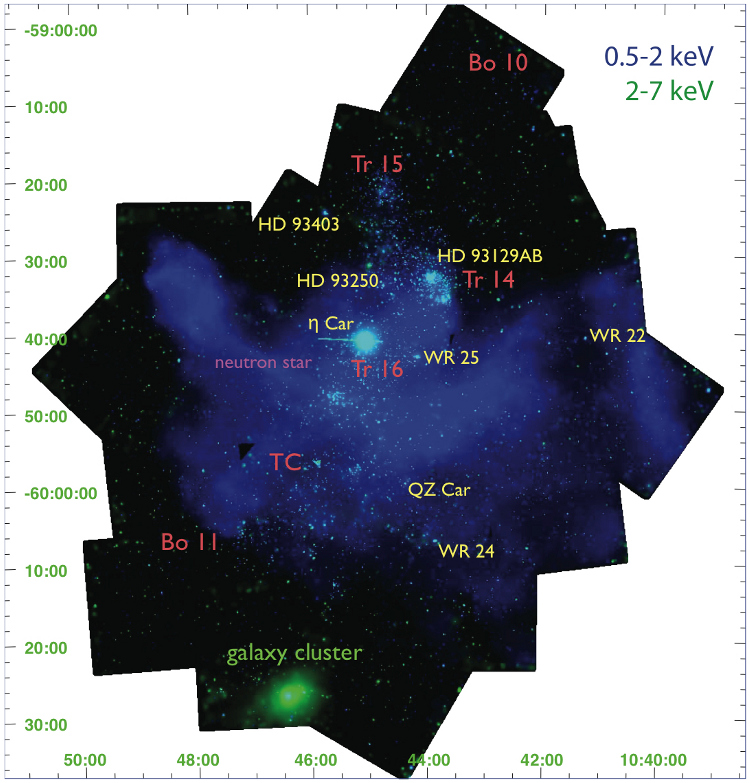
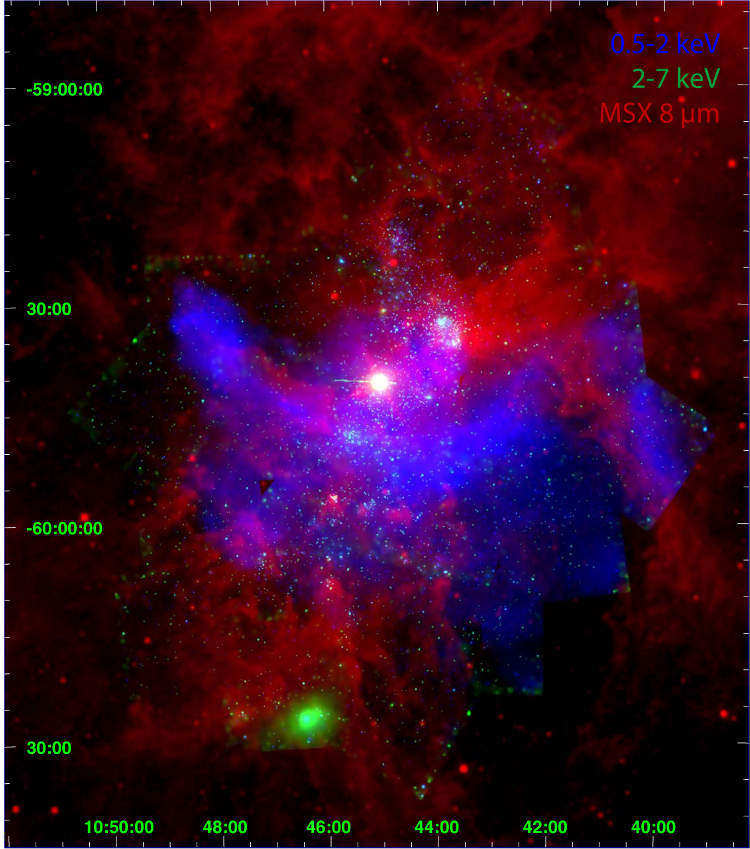
X-ray image of the Carina Nebula
|
Optical image of the Carina Nebula (ESO Images) |
Information on the
|
X-ray image of the Carina Nebula |
At a distance of 2.3 kpc, the Great Nebula in Carina is the nearest region with a large population of very massive young stars. The Carina Nebula Complex is a superb site to study the violent massive star formation and feedback that typifies giant HII regions and starburst galaxies.
The Young Stars and Star Formation Group at Munich Observatory is performing observations of the Carina Nebula in a wide range of different wavelengths, from X-rays to the radio regime. More information about our multi-wavelength Carina studies can be found here.
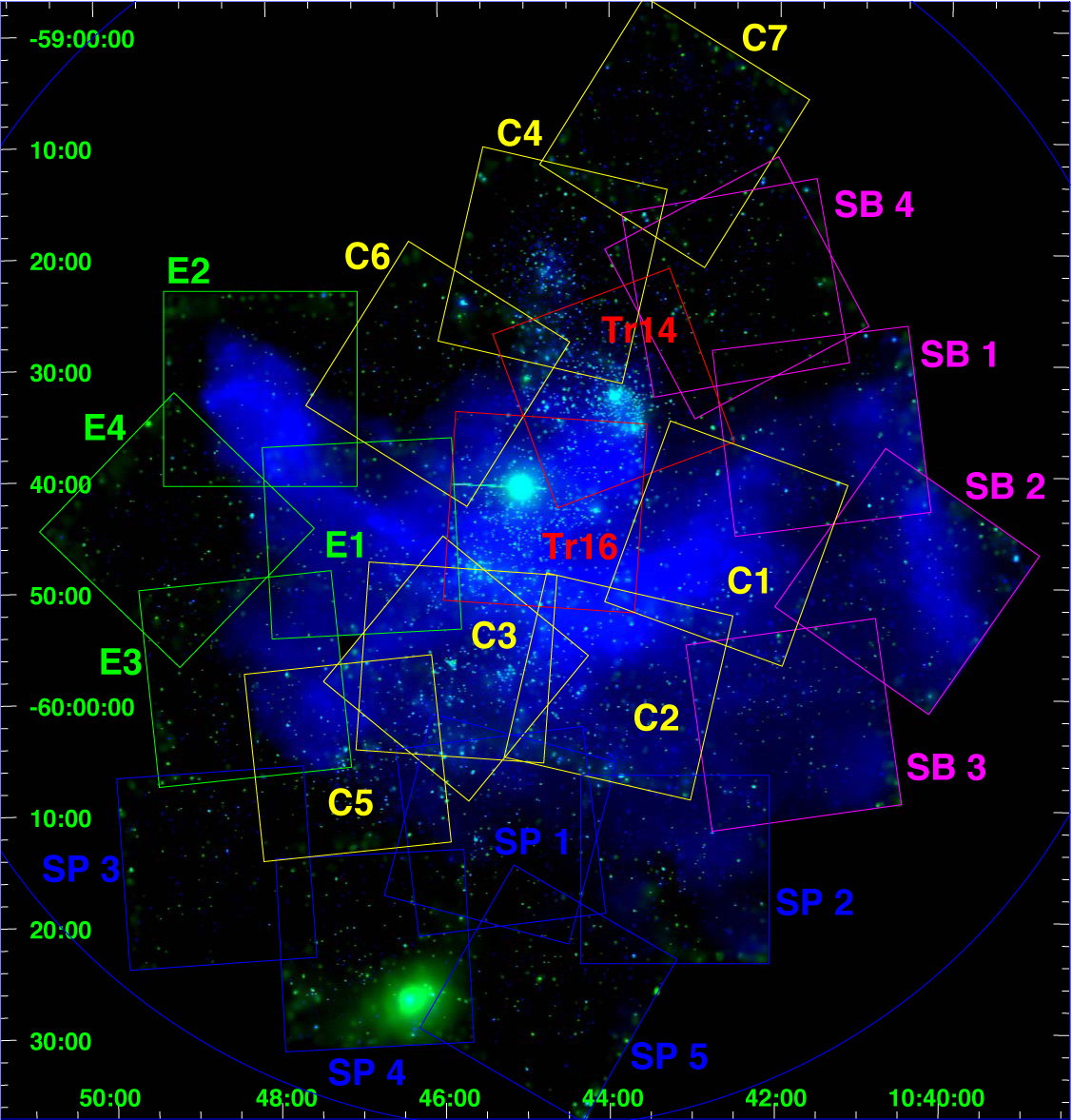
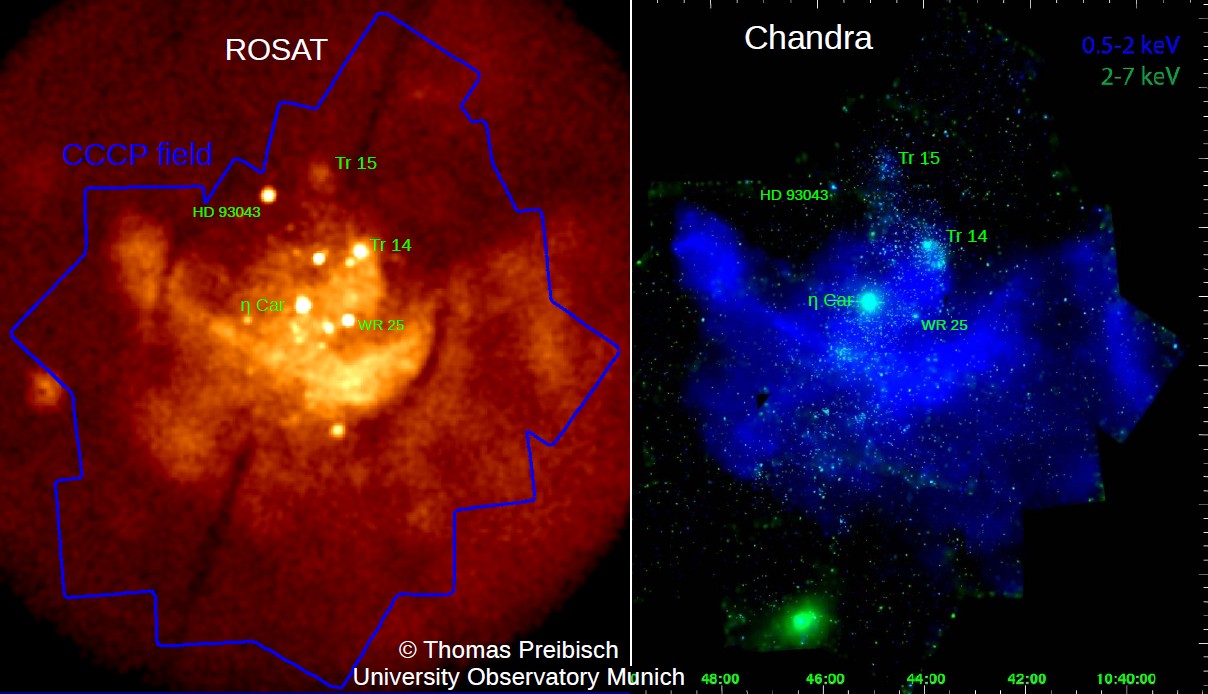
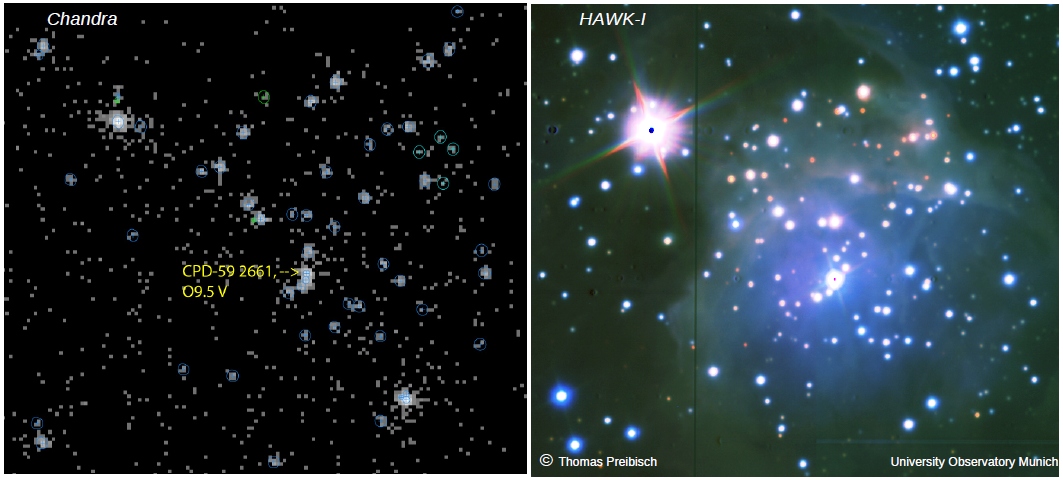
A very important part of our Carina studies is our involvement in the Chandra Carina Complex Project (CCCP), which is led by Leisa Townsley (Penn State University). The CCCP has used 1.5 Megaseconds (17.4 days) Chandra observing time to perform a 1.4 square-degree X-ray survey of the Carina Complex. The analysis of the X-ray data revealed 14368 individual X-ray point-sources as well as diffuse X-ray emission. Based on their X-ray properties, 10714 of the 14368 detected X-ray sources can be classified as very likely young stars in Carina; their strong X-ray emission allows to discern them from the numerous much older field stars in the area. These Chandra X-ray data efficiently eliminate the strong confusion problems that plague visual and IR samples and provide, for the first time, a statistically complete sample of the young stellar population in the Carina Complex.
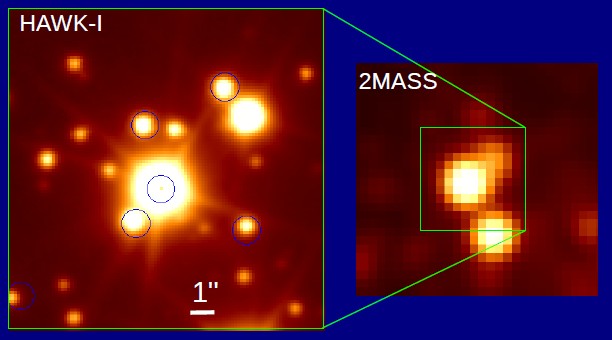
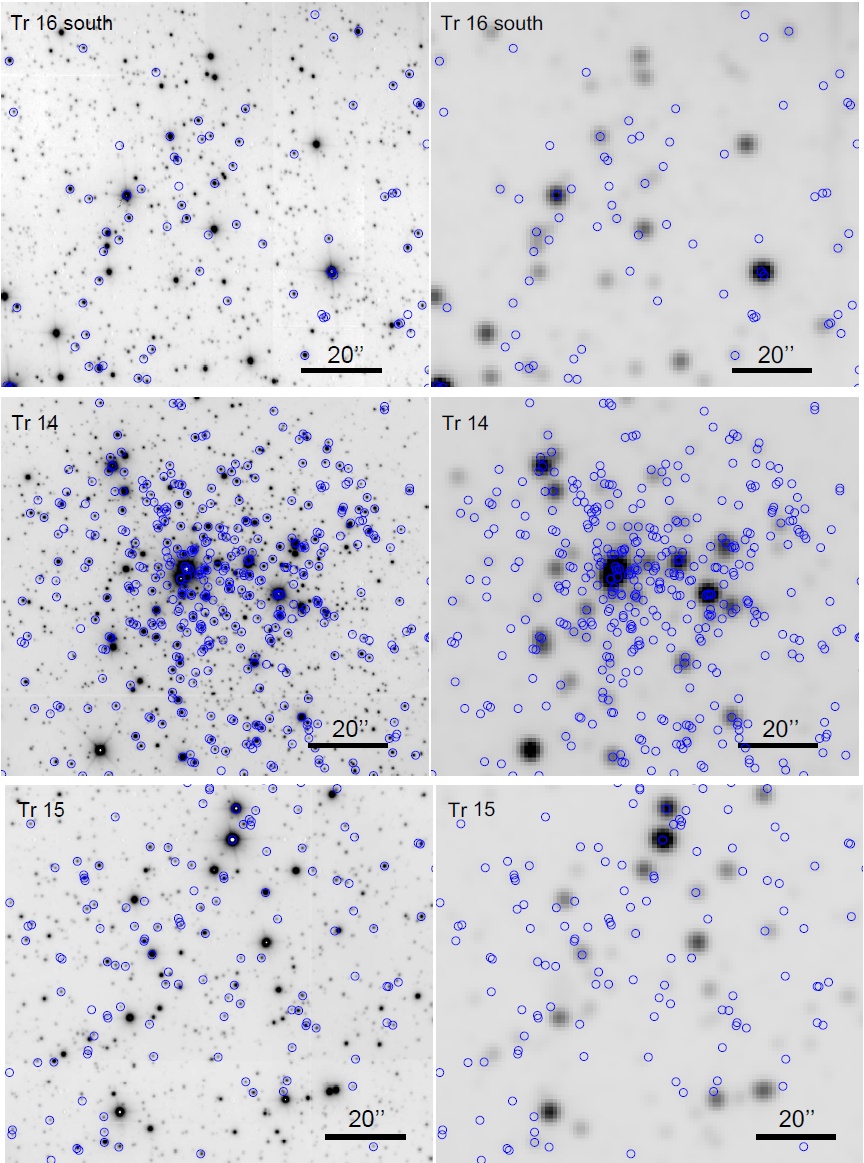
Our main contribution to the CCCP was a very deep near-infrared survey of the central parts of the Carina Complex. The correlation of our infrared catalog (comprising more than 600 000 sources within a 1280 square-arcmin area) with the X-ray source list from the CCCP provided infrared identifications for 90% of the X-ray sources in the survey area. First results of this infrared - X-ray study are published in this paper.
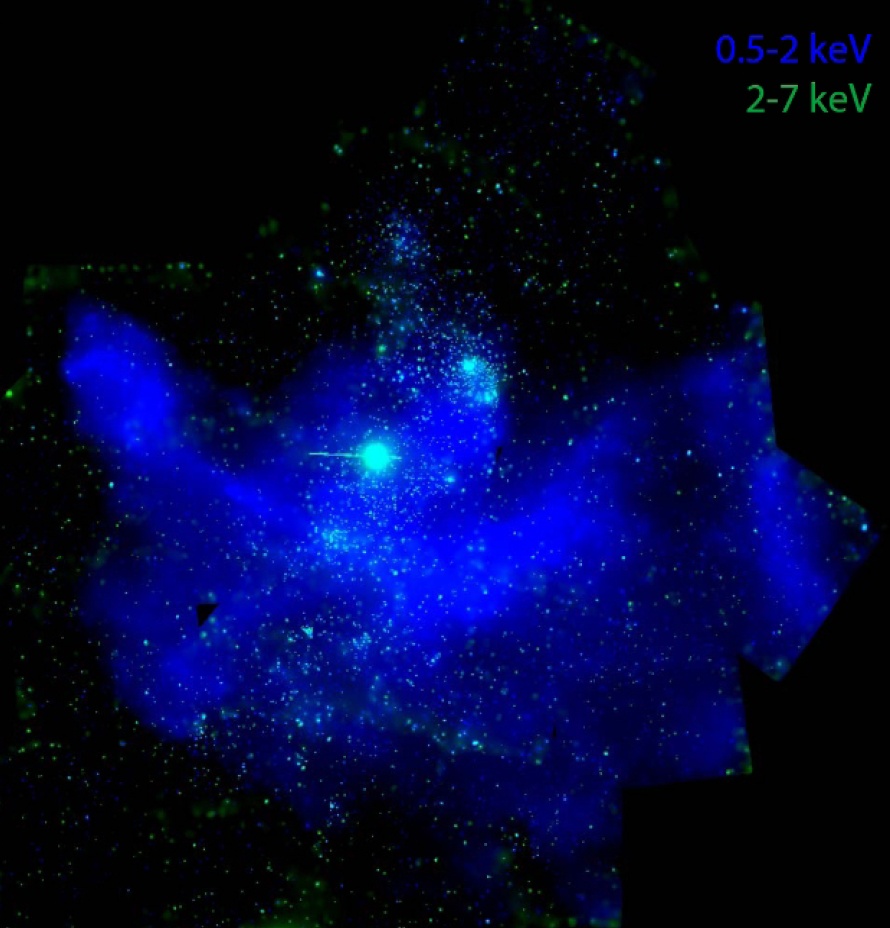
Below I have collected a few interesting X-ray images. For more information,
see the CCCP special issue,
take a look at the
Chandra Press Release
or the report on the project in the
NEWS & VIEWS
article in Nature.
The first 16 CCCP papers have been published in a
special issue of the ASTROPHYSICAL JOURNAL SUPPLEMENTS in May 2011.